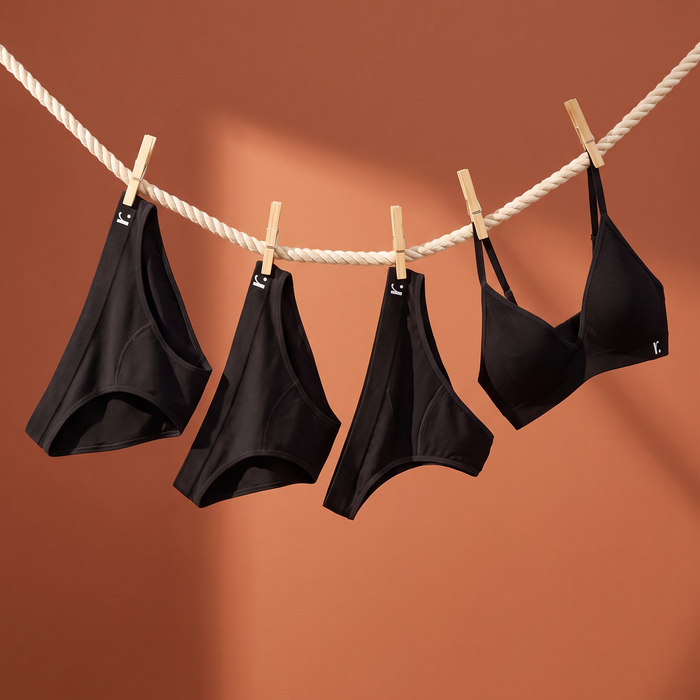
Period Brief or High-Waist Brief? How to Choose Your Rudies

Choosing between our Period Brief and High-Waist Brief comes down to two separate questions: where do you like your waistband to sit, and how much absorbency do you need? The High-Waist Brief has a fuller cut and a higher manufacturer reference absorbency. That does not make it the right pair for every day or every body.
If you prefer less fabric around your middle and the lower absorbency suits your flow, start with the Period Brief. If you want a higher waistband, fuller coverage and more absorbency within our range, look at the High-Waist Brief.
Period Brief vs High-Waist Brief: the differences
| What to compare | Period Brief | High-Waist Brief |
|---|---|---|
| Cut | Everyday brief, less coverage than the high-waist | Higher rise, fuller coverage |
| Reference absorbency* | 10 to 15 ml | 20 to 25 ml |
| Absorbent core | One bamboo-and-cotton core layer | Two bamboo-and-cotton core layers |
| Body fabric | 92% bamboo viscose, 8% elastane | 92% bamboo viscose, 8% elastane |
| Current single-pair price | $32.99 AUD | $34.99 AUD |
*Manufacturer reference ranges help compare our styles. They are not a guarantee of wear time or protection for your individual flow. Prices checked on 29 October 2026; see the product pages for current prices.
Both styles have a seamless knitted body and a multi-layer absorbent gusset. The core-layer count refers to the absorbent part of that gusset, not the total number of layers in the whole garment.
Choose the waistband you want to wear
Think about the undies you reach for when you have a choice. If a high waistband feels good to you, the High-Waist Brief gives you more fabric around your middle. If you prefer a lower rise, the Period Brief may feel more familiar.
Neither preference needs fixing. You do not have to choose a higher cut just because you are on your period, and you do not have to stick with your usual cut if you want more coverage.
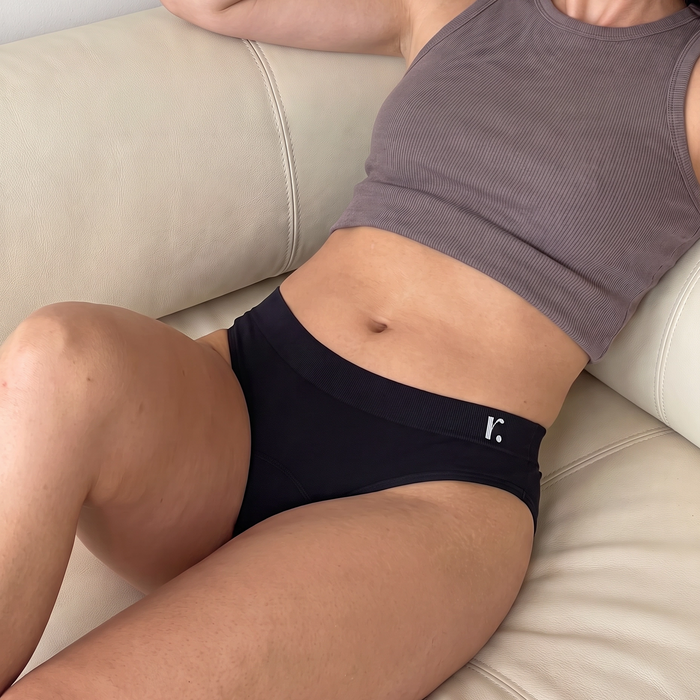
Check the waistband against the trousers, skirts or shorts you actually wear. A pair can look right on a product page and still sit somewhere you find annoying under your favourite jeans. Look at the product photos and current size guide before ordering.

Compare absorbency separately from the shape
Our High-Waist Brief has the higher reference capacity because its absorbent core uses two layers, compared with one in our everyday brief. The extra height of the waistband is not what absorbs your flow.
That distinction helps when you shop across brands, too. “High-waist” describes a cut. It does not tell you the capacity of a pair or how far its absorbent panel extends.
If the Period Brief's reference range is enough for the part of your cycle you are planning for, you do not need to move up to the high-waist just because it holds more. If you want more capacity within our range, compare the High-Waist Brief. If neither offers what you need, use another arrangement that does.
Do not turn the millilitre figures into a promise of hours. A higher reference capacity does not mean you can ignore how the pair feels or delay a change when it is damp, uncomfortable or leaking.
What would make you choose each pair?
- You prefer an everyday brief shape: look at the Period Brief, then check whether its absorbency suits the wear you have in mind.
- You want a higher rise and more coverage: look at the High-Waist Brief. Check its fit as well as its capacity.
- You want the most absorbent Rudie brief: the High-Waist Brief has the higher manufacturer reference range. It still has limits.
- You want more capacity but dislike high waistbands: take that preference seriously. Do not buy a cut you already find uncomfortable just to get the larger number.
You can also wear different cuts at different points in your cycle.
Check the fit before deciding the cut is wrong
Use each product's current size guide rather than sizing down to make it feel more secure. A pair should sit close without digging in, and the leg openings should not leave gaps you keep trying to adjust.
Try ordinary movements when assessing the fit: sitting down, bending and walking. If the waistband rolls or the pair shifts, reconsider the size and cut instead of assuming that is something you have to put up with.
For visible lines under clothing, see our seamless period-underwear guide. For bedtime, our overnight guide goes into coverage and first-night planning.
Both briefs follow the same approved care routine. Our washing guide covers the cold rinse, gentle cold wash and full air dry.
Choose the pair for the day you are dressing for, the flow you need to manage and the cut you want to wear. More fabric and more capacity are useful options, not an obligation.